Before working with a new client, we tend to hear the same frustrations again and again.
- The business is solid.
- The product or service is genuinely good.
- Customers are happy.
- Referrals come in consistently.
- Sales conversations usually go well once they start.
And yet Meta ads feel unreliable, expensive, or unpredictable.
This pattern shows up across industries and budgets. It does not usually mean the business is doing something wrong. More often, it reflects a mismatch between how Meta ads work and how many good businesses expect them to behave.
“We Know Our Business Is Good, But the Ads Just Don’t Work”
One of the first things we usually hear is a mix of confidence and uncertainty.
Business owners know their offering is strong. They’ve seen it convert through referrals, email, and direct conversations. When they bring that same business to Meta, they naturally expect those strengths to carry across.
What they quickly realise is that Meta operates in a very different environment.
People aren’t actively searching; they’re scrolling. Attention is brief, context is limited, and decisions are made fast. Ads have only a split second to signal relevance.
Many good businesses depend on explanation, nuance, or reputation to sell. That works well once someone is engaged, but it doesn’t always translate effectively in a cold, fast-moving feed.
“Meta Should Be Creating Demand for Us”
Another frustration we often hear is the belief that Meta should create interest from scratch.
Businesses frequently approach Meta in the same way they approach Google or direct sales, expecting the platform to educate, persuade, and guide people through the decision-making process.
In reality, Meta works best when it can identify people already showing behavioural signals of interest or intent. It amplifies existing demand rather than creating it.
When campaigns are built on the assumption that Meta will handle most of the education, performance tends to struggle early on and rarely settles into consistency.
“We’ve Tried Ads Before, and They Didn’t Perform”
This usually comes with a list of things that have already been tried.
Different creatives.
Different audiences.
Different budgets.
Different agencies.
What’s often missing is continuity.
Before working together, many businesses take a cautious approach. Budgets are kept tight. Campaigns are paused quickly. Changes are made frequently in response to early results.
That caution is understandable, but it can stop Meta from gathering enough data to learn effectively. Ads are often judged before the platform has had time to identify meaningful patterns.
“The Ads Look Good, But Results Don’t Match”
Creative quality is another common point of frustration.
Before working with us, many businesses run ads that are well designed, carefully written, and brand safe. The creative represents the business accurately and professionally.
What they often struggle with is directness.
Meta users are not evaluating brand consistency or messaging nuance. They are looking for relevance and outcomes. Ads that are too careful can fail to communicate quickly enough, even when the underlying offer is strong.
This is rarely about lowering standards. It is about prioritising clarity over polish.
“We Don’t Want to Waste Money”
This concern underpins almost every conversation.
Good businesses are rightly protective of their budgets. They want reassurance that spending is working and results are improving.
The challenge is that Meta’s delivery system relies on stability. When campaigns are constantly adjusted, paused, or restarted, the platform loses the context it needs to optimise effectively.
Before working together, many businesses interpret volatility as failure, when in reality it is often a sign that the system has not been given the conditions it needs to settle.
What Changes When the Approach Changes
When these frustrations are addressed, the business itself usually does not need to change.
What changes is how quality is translated into signals that Meta understands.
Messaging becomes clearer and more outcome focused. Creative covers different levels of awareness. Campaigns are allowed to run long enough to produce meaningful data. Decisions are made based on trends rather than early movement.
In many cases, Meta stops feeling unpredictable once expectations, structure, and creative are aligned with how the platform actually works.
Ready to Make Paid Social Work the Way It’s Meant To?
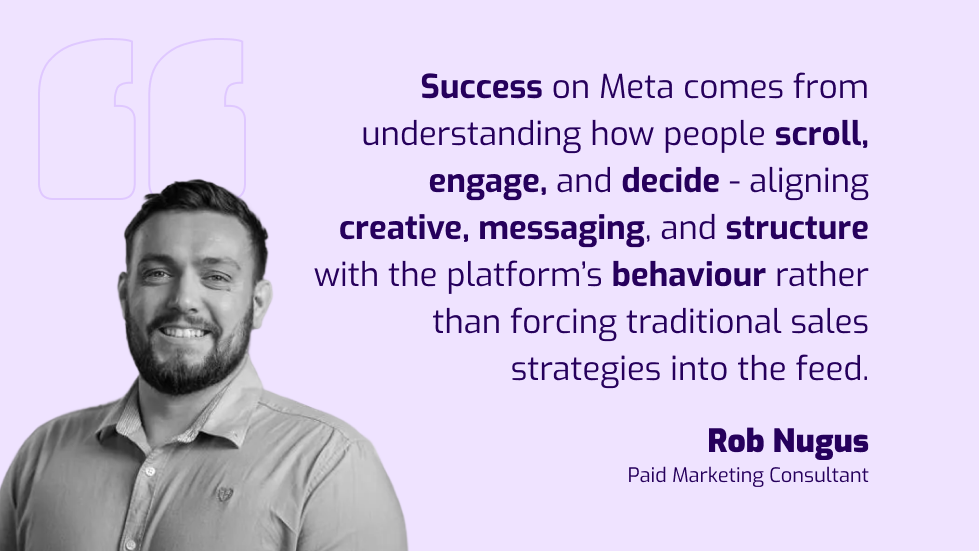
The data is clear: brands that succeed on paid social understand how platforms like Meta actually behave. Performance comes from aligning messaging, creative, and structure with how people scroll, engage, and make decisions, not forcing traditional sales thinking into a feed environment.
At Unity Online, we help businesses turn strong products and services into signals Meta understands. That means clearer outcomes, smarter targeting, and campaigns built to learn, stabilise, and scale, not stop-start testing that never gets traction.
We’ve helped businesses move past unpredictable results by focusing on what paid social does best: amplifying existing demand, improving relevance, and driving measurable growth over time.
Our team is down-to-earth, data-led, and honest about what works, and what doesn’t, on paid social today.
Get in touch to see how we can help you build paid social campaigns that deliver clarity, consistency, and real results in the year ahead.
Have a project you would like to discuss? Request a call from one of our experts